
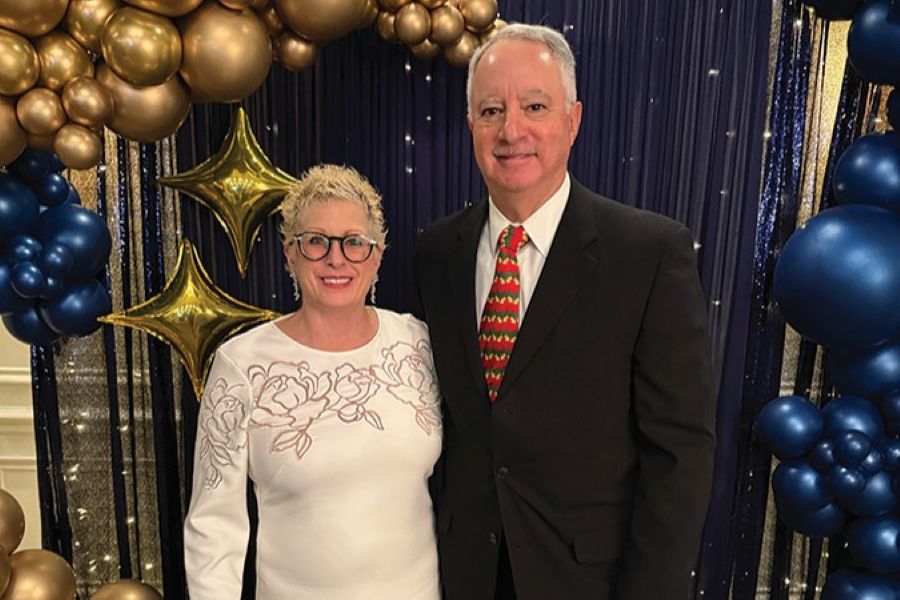
 When Kim Roberts of Smyrna began experiencing abdominal pain and fluid buildup in her abdomen, she did not expect the symptoms to lead to an ovarian cancer diagnosis. What followed was a surprising journey of tests, surgery and chemotherapy — and a mindset she calls “Kim Possible.” Drawing on optimism, imagination and the support of her care team, Kim found strength through treatment and ultimately reached remission.
What were the events that led up to your cancer diagnosis?
Ovarian cancer is the silent killer. Most women who have the disease are not diagnosed until it is stage III or stage IV.
In August 2024, I saw my OB/GYN, Dr. Winifred Soufi, and she noticed cysts on my ovaries. Dr. Soufi asked how I felt, so I told her that I had abdominal pain and that I had ascites (fluid buildup in the abdomen). In December 2024, she suggested I have an ultrasound.
Ultrasounds should not hurt, but mine did. Dr. Soufi sent me to Northside Hospital for another ultrasound. It hurt too. She then sent me to Dr. Adam Pyrzak, a gynecologic oncologist, and he scheduled an MRI.
The ultrasounds and the MRI did not show any problems, but blood tests showed I was menopausal, perimenopausal and that I was producing estrogen. Dr. Pyrzak thought the estrogen may have been feeding cancer. I decided to have both ovaries and fallopian tubes removed. During the surgery, he also took biopsies.
After the surgery, he told my family and me that he saw no evidence of cancer and that it was “much ado about nothing.” On March 23, 2025, I was diagnosed with stage IIB adult granulosa cell ovarian cancer via a phone call from Dr. Pyrzak. He was blown away, and I was too. Dr. Soufi called the next day to talk with me about my test results. She was also blown away by the diagnosis. An appointment with Dr. Pyrzak was quickly scheduled to determine a plan.
What treatment did you receive?
I had a bilateral salpingo-oophorectomy (surgery to remove my ovaries and fallopian tubes) with biopsies and six cycles of chemotherapy.
I told Dr. Pyrzak it was time to put my big-girl panties on and jump the next hurdle. He said, “Don’t lose that attitude! That’s what you need to fight cancer!”
Our attitudes make a huge difference. Making the decision to thrive during treatment is the best decision you can make.
Did you utilize patient support resources at Northside Hospital Cancer Institute? If so, which would you recommend?
Yes. The nurses and doctors at the Northside Hospital Infusion Center took excellent care of me. I also spoke with a Northside counselor and attended activities at Cancer Support Community Atlanta.
My recommendations are to get to know the nurses who take care of you and speak with a counselor if you’re feeling depressed — counselors can help put things into perspective. Additionally, find a support group.
What advice do you have for someone navigating their treatment and recovery journey?
I am a retired elementary school teacher, and many years ago on the first day of school, a kindergartener asked me if my name was Kimberly Roberts. I replied, “No, my name is Kim Possible!” (the popular Disney Channel character).
That was it. My students were The Little Possibles and I was KP, or Ms. Roberts. When I had something to teach, I would play the Kim Possible theme song or the Mission: Impossible theme song. We would sing and dance, and I would lean toward The Little Possibles and say, “This is your job if you so choose to accept it!” Then I would teach my lesson.
Our mantra is a quote by Audrey Hepburn: “Nothing is impossible. The word itself says, ‘I’m possible.’”
Not one Little Possible ever said, “I can’t” or “I won’t.” They tried their best. Always.
Kim Possible took over once I was diagnosed with ovarian cancer. I envisioned Gladiator from the original movie as the carboplatin. He was slaying all the ovarian cancer cells in my body. Then I envisioned Jaws as paclitaxel, chomping all the ovarian cancer cells he could, as well as eating those that were missed by Gladiator.
When I focused on Gladiator and Jaws doing their jobs, I felt in control of my cancer journey. I was out to beat ovarian cancer — and I did.
How far out are you from treatment, or is treatment ongoing?
I was told in August that I am in remission. That declaration from Dr. Pyrzak, Alli Cansler (his NP) and my brother was mind-boggling. I had fought for several months, and to be told I was finished fighting the good fight was a new and different sensation.
I am Kim Possible; I was not finished fighting. I had never been told by my pediatric cardiologists that I was free of heart disease, so being NED (no evidence of disease) felt strange to me.
Closing thoughts
If you are fighting cancer, then find your possible. You can do it. You have the strength within yourself to fight the good fight.
Find your Gladiator and your Jaws. In your mind, envision them crunching, slaying, slicing and dicing the cancer cells that disappear from your body once they have been obliterated.
Put your big-girl panties (or your big-boy tighty-whities) on — and feel possible.
LEARN MORE ABOUT OVARIAN CANCER CARE AT NORTHSIDE.
*The health story shared here is for informational purposes only and is not medical advice. Patients should consult with their own physician before making medical decisions.
